

The visit has opened a new phase in bilateral cooperation, with development financing, cross-border infrastructure and energy security placed at the centre.
Key Highlights
- ₹15,000-crore assistance: India announced ₹3,500 crore in grants for reconstruction and infrastructure, alongside an ₹11,500-crore rupee-denominated line of credit for energy projects.
- Rail connectivity: The Sarayu-Kamala Express between Ayodhya and Janakpur was launched, while the final location survey for the Raxaul-Kathmandu railway was completed.
- Border infrastructure: A motorable bridge connecting Dharchula and Darchula was inaugurated, and a new Integrated Check Post at Banbasa was taken up.
- Energy cooperation: The foundation stone was laid for the 669 MW Lower Arun Hydroelectric Project, while Phase II of the Motihari-Amlekhgunj petroleum pipeline was dedicated to Nepal.
- New transit routes: Nepal was given access to Deendayal Port at Kandla, with access to Paradip Port to follow after the required infrastructure is developed.
- Eight institutional agreements: Cooperation was expanded in forensic science, policing, civil-service training, traditional medicine, satellite communications, urban development, healthcare, livestock and fisheries.
- Ten-pillar roadmap: The two countries adopted the “Viksit Bharat and Samunnat Nepal” Joint Vision, covering economic cooperation, connectivity, energy, technology, education, health, agriculture, sports and tourism.
A Diplomatic Visit with a Development Agenda
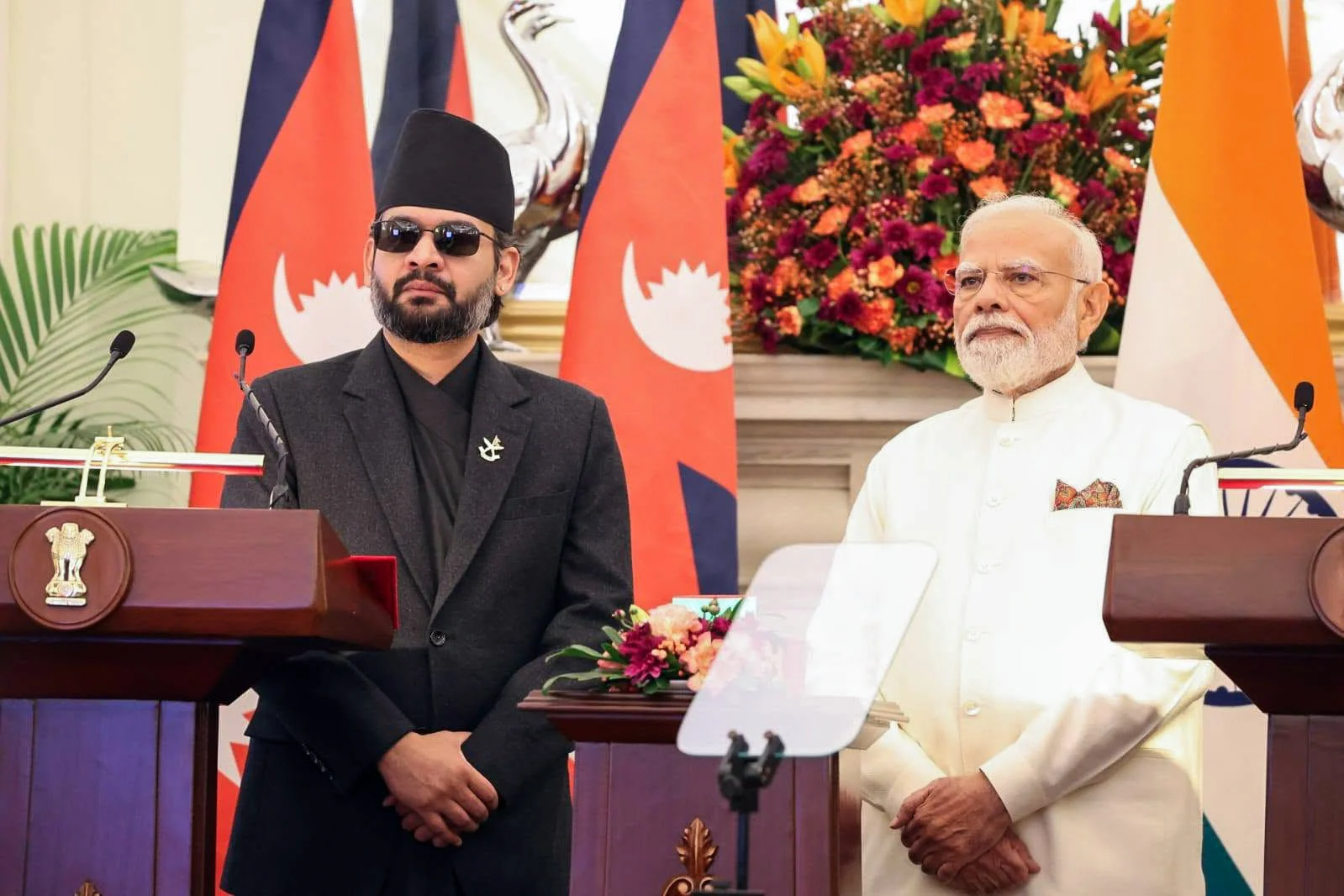
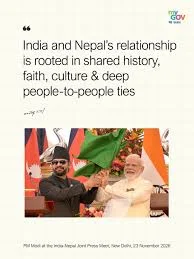
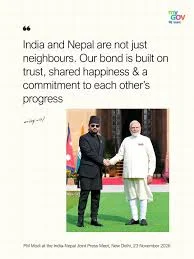
India and Nepal have sought to give their longstanding relationship a more practical and forward-looking direction following the state visit of Nepal Prime Minister Balendra Shah to New Delhi on November 22–23, 2026.
Invited by Prime Minister Narendra Modi, Shah was accompanied by a high-level official delegation. The visit was his first state visit to India since assuming office. He was accorded a ceremonial welcome at Rashtrapati Bhavan, paid homage to Mahatma Gandhi at Rajghat and called on President Droupadi Murmu. External Affairs Minister S. Jaishankar also met the visiting Prime Minister.
The bilateral discussions were centred on development cooperation, infrastructure, energy, trade, regional connectivity and people-to-people relations. A number of projects were inaugurated or taken forward, while fresh commitments were announced across sectors ranging from hydropower and transport to education and digital technology.
The most consequential announcement was the ₹15,000-crore development assistance package. It was accompanied by a joint vision document intended to guide the next phase of the partnership.
The outcomes indicate that both governments are seeking to strengthen the relationship through projects that can improve Nepal’s access to markets, support reconstruction and create opportunities for investment and employment.
₹15,000-Crore Assistance: What Does the Package Include?
India announced development assistance worth ₹15,000 crore, equivalent to NPR 24,000 crore, to support Nepal’s post-disaster reconstruction and long-term development.
The package has two components:
- ₹3,500 crore in grant assistance: Intended for post-disaster reconstruction and new infrastructure projects.
- ₹11,500 crore in a rupee-denominated Line of Credit: Earmarked for energy-sector projects.
The distinction is important. The entire ₹15,000 crore is not a grant; the larger component is a line of credit that will support energy projects through a financing arrangement. Specific projects and the modalities for providing the assistance are to be finalised through mutual consultations between the two governments.
The announcement comes after devastating floods and debris flows affected Nepal’s Rasuwa–Trishuli basin and other areas in August 2026. Significant loss of life and damage to property were reported. India had extended humanitarian and technical assistance, including search-and-rescue support, following the disaster.
The reconstruction component is expected to support affected communities and infrastructure, while the energy-related credit is intended to strengthen Nepal’s hydropower and transmission capacity.
For Nepal, the package provides an important financing commitment at a time when reconstruction and infrastructure development remain major priorities. For India, it reinforces its role as a development partner in a neighbouring country with which it shares extensive economic, geographical and cultural links.
However, the announcement should not be confused with immediate disbursement. Project selection, financing arrangements and implementation timelines will require further consultations.
Ayodhya–Janakpur Rail Link Strengthens Cross-Border Connectivity
Rail connectivity was among the most visible outcomes of the visit.
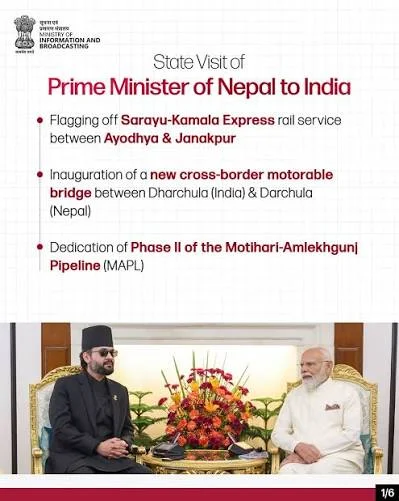
The two Prime Ministers flagged off the Sarayu-Kamala Express between Ayodhya in Uttar Pradesh and Janakpur in Nepal. The service is expected to improve passenger connectivity while supporting religious and cultural tourism along the Ramayana Circuit.
Ayodhya and Janakpur hold an important place in the shared religious traditions of India and Nepal. Better transport links between the two destinations could make pilgrim travel more convenient and create opportunities for local businesses, tourism operators and communities.
The leaders also agreed to explore similar connections for Buddhist and Shiv-Shakti religious tourism circuits. These could link destinations such as Lumbini, Bodh Gaya, Sarnath, Kushinagar, Kathmandu and Varanasi.
Another important development was the finalisation of the Field Location Survey for the proposed Raxaul–Kathmandu electrified broad-gauge railway line. The two sides also agreed to collaborate on the development of Nepal’s East-West Railway, with priority to be given to selected sections connecting the wider network with India.
The joint vision also calls for the completion of pending sections of the Jayanagar–Bardibas and Jogbani–Biratnagar railway lines.
These projects matter beyond passenger movement. More efficient rail connections can reduce transport costs, support trade and provide Nepal with improved access to regional markets.
Bridges, Integrated Check Posts and New Transit Routes
Road and border infrastructure formed another major part of the discussions.
A new motorable bridge connecting Dharchula in Uttarakhand with Darchula in Nepal was inaugurated. The bridge is expected to improve direct connectivity between western Nepal and India, making movement easier for residents and supporting local trade.
The foundation stone was also laid for a new Integrated Check Post (ICP) at Banbasa. Progress in the construction of ICPs at Bhairahawa, Sunauli and Dodhara-Chandani was reviewed. Three integrated check posts between the two countries are already operational.
Such facilities are intended to improve the movement of people and goods, strengthen customs procedures and support better coordination at border crossings.
A significant announcement was also made on Nepal’s access to Indian ports. Deendayal Port at Kandla in Gujarat will provide an additional route for Nepal’s transit trade. Access to Paradip Port in Odisha will also be made available once the required infrastructure is in place.
As a landlocked country, Nepal depends on transit arrangements with neighbouring countries for access to international markets. Additional port options could provide greater flexibility in cargo movement and help diversify trade routes.
The two governments also agreed to make the existing Kathmandu–Bhairahawa–Lucknow air route bidirectional. Technical consultations will be required to finalise the operational arrangements.
Hydropower and Petroleum Infrastructure Take Centre Stage
Energy cooperation remains one of the strongest economic pillars of India-Nepal relations. Nepal has substantial hydropower potential, while India offers a large electricity market and opportunities for investment, transmission and cross-border power trade.
During the visit, the foundation stone was laid virtually for the 669 MW Lower Arun Hydroelectric Project. The project is expected to add to Nepal’s electricity-generation capacity and strengthen the role of Indian companies in the country’s hydropower sector.
The two Prime Ministers also called for faster progress on the Pancheshwar Multipurpose Project. The Pancheshwar Development Authority and the Joint Committee on Water Resources were directed to expedite the finalisation of its Detailed Project Report and move towards implementation.
Work on the Detailed Project Reports for the Saptakoshi and Sunkoshi multipurpose projects is also expected to be accelerated. These projects have wider significance because shared river systems can be used for electricity generation and water management, while coordinated planning can help mitigate flood-related risks.
On petroleum infrastructure, Phase II of the Motihari–Amlekhgunj Oil Pipeline was dedicated to the people of Nepal. The foundation stone was also laid for a petroleum terminal at Jhapa, which forms part of the proposed Siliguri–Jhapa petroleum pipeline.
Both governments agreed to explore cooperation on gas pipelines between the two countries. Progress was also noted on joint ventures for two high-capacity cross-border electricity transmission lines connecting Inaruwa with New Purnea and Dododhara with Bareilly.
The wider objective is to build a more integrated energy relationship in which Nepal’s hydropower resources can be developed and electricity trade can be expanded according to mutual benefit and market demand.
Eight MoUs Expand Cooperation Beyond Infrastructure
The visit was not limited to financial assistance and physical infrastructure. Eight Memoranda of Understanding were exchanged to strengthen cooperation across institutional, technical and public-service sectors.
The agreements cover academic and research collaboration between India’s National Forensic Sciences University and Nepal Police’s Crime Investigation Department, as well as cooperation between India’s Rashtriya Raksha University and Nepal’s National Police Academy.
A separate agreement between the National Centre for Good Governance and Nepal Administrative Staff College is intended to support training and capacity-building programmes for Nepal’s civil servants.
Other agreements cover Ayurveda and traditional systems of medicine, satellite communications, sustainable urban development, healthcare, livestock and fisheries.
The satellite communications agreement between the Indian Space Research Organisation and Nepal’s Ministry of Information and Communication is particularly significant. It is intended to establish a satellite communication network for the utilisation of the South Asia Satellite.
The agreements are expected to provide institutional channels for sharing technical expertise, strengthening professional training and improving cooperation between public agencies.
An offshore campus of an Indian Institute of Technology (IIT) was also agreed upon. The initiative is expected to expand higher-education opportunities in Nepal and support technical skills, research and employment.
In agriculture, an Agro-Industrial Park is to be established in Chitwan with grant assistance from India. The project is intended to support value addition to Nepali agricultural products and strengthen links between farming, food processing and markets.
‘Viksit Bharat and Samunnat Nepal’: A Ten-Pillar Partnership
One of the most important political outcomes was the adoption of the joint vision document titled “Viksit Bharat and Samunnat Nepal: Re-imagining the Partnership.”
The document is designed to provide a long-term roadmap for bilateral cooperation. It brings together traditional areas such as trade, energy, water resources and connectivity with newer priorities involving technology, innovation, climate resilience and youth development.
The ten pillars cover:
- Economic and development partnership: Trade, investment, cross-border industrial parks and development assistance.
- Physical and digital connectivity: Railways, roads, aviation, border infrastructure, petroleum pipelines and digital payments.
- Energy, water resources and climate resilience: Hydropower, electricity trade, multipurpose river projects and disaster preparedness.
- Good governance: Digital public infrastructure, e-governance and civil-service capacity building.
- Technology, space and innovation: Start-ups, digital parks, artificial intelligence, satellite development and next-generation telecommunications.
- Education and skill development: Higher education, scholarships, vocational training and academic exchanges.
- Sports: Cricket infrastructure, training academies and cooperation in other sporting disciplines.
- Culture and tourism: Religious tourism circuits, cultural exchanges and youth festivals.
- Health: Medical infrastructure, affordable medicines, institutional cooperation and professional training.
- Agriculture: Agro-industrial development, agricultural research, livestock training and value addition.
The roadmap also places emphasis on young people, entrepreneurship and employment. The proposed start-up cooperation network, innovation facilities and digital infrastructure are intended to create opportunities beyond conventional government-to-government engagement.
For Nepal, these areas are relevant to its ambitions to expand employment, strengthen domestic industries and improve access to technology. For India, deeper cooperation can support regional economic integration and strengthen its development partnership with a close neighbour.
Sensitive Issues Remain on the Diplomatic Agenda
Despite the wide range of announcements, several longstanding issues between India and Nepal remain unresolved.
The joint vision document states that existing bilateral agreements, including the 1950 Treaty of Peace and Friendship, could be reviewed on the basis of mutual consent. It also reiterates that outstanding matters relating to water resources, energy, trade and commerce, and the boundary are to be resolved through dialogue.
The joint press release records progress in field work relating to the maintenance and repair of boundary pillars. Foreign Secretaries have been directed to work on outstanding boundary issues.
However, no final settlement of the boundary dispute or revision of the 1950 treaty was announced during the visit. The Pancheshwar Multipurpose Project also remains dependent on further progress in finalising its Detailed Project Report and implementation arrangements.
These matters require sustained political engagement and technical negotiations. Their resolution will be important for ensuring that the wider economic partnership is supported by mutual confidence.
The distinction between a broad commitment to dialogue and an actual settlement is important. The visit created a framework for continued engagement, but it did not resolve every sensitive issue in the bilateral relationship.
From Announcements to Implementation: The Road Ahead
The scale of commitments announced during Shah’s visit has given fresh momentum to India-Nepal relations. Yet the success of the visit will ultimately be measured by the delivery of projects rather than the number of agreements signed.
To strengthen implementation, the two Prime Ministers agreed to activate a High-Level Monitoring Group led by Nepal’s Foreign Secretary and India’s Ambassador to Nepal. The group is expected to meet at least once every six months, review progress and facilitate the clearances and approvals required for projects and initiatives.
Its reports will be submitted to the India-Nepal Joint Commission, co-chaired by the Foreign Ministers of both countries. The next meeting of the Joint Commission is scheduled to be held in 2027.
This monitoring arrangement will be particularly important for large infrastructure projects, which require coordination across ministries, state governments, technical agencies and private-sector partners. Timely land clearances, financing decisions, technical assessments and cross-border procedures will determine how quickly the commitments translate into results.
For Nepal, improved access to ports, energy investment, rail links and development financing could support economic growth and reduce logistical constraints. For India, stronger connectivity and energy cooperation would reinforce its Neighbourhood First policy and deepen economic ties across the Himalayan region.
The visit has therefore established a broad agenda for the next phase of bilateral relations. Its real significance will depend on whether the political commitments made in New Delhi are converted into functioning infrastructure, reliable energy links and tangible opportunities for people on both sides of the border.
Share this Perspective
Spread rigorous policy evaluation across your professional networks.