
India’s response to the USCIRF report has renewed debate over religious freedom, international scrutiny, diplomatic relations and national sovereignty.
Key Highlights
- India rejected the USCIRF’s 2026 Annual Report, describing its assessment as motivated, biased and selective.
- The report recommended that the US State Department designate India as a Country of Particular Concern (CPC) over alleged serious violations of religious freedom.
- Targeted sanctions were recommended against the RSS and India’s Research and Analysis Wing (R&AW), including possible asset freezes and entry restrictions.
- The Ministry of External Affairs (MEA) questioned the report’s sources and methodology, and referred to attacks on Hindu temples in the United States.
- A separate statement by 275 former judges, civil servants and armed forces veterans also criticised the report, raising questions about its balance and credibility.
A Report That Has Reopened a Diplomatic Disagreement
India’s latest disagreement with the United States Commission on International Religious Freedom (USCIRF) has once again placed religious freedom assessments at the centre of a wider diplomatic debate. The immediate trigger was the commission’s 2026 Annual Report, which examined religious freedom conditions across several countries during 2025 and recommended that India be designated a Country of Particular Concern (CPC).
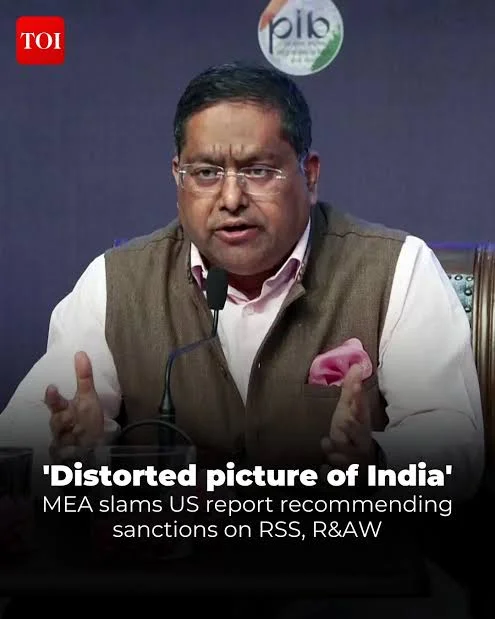
The report went beyond criticism of government policies. Targeted sanctions were also recommended against two Indian organisations — the Rashtriya Swayamsevak Sangh (RSS) and the Research and Analysis Wing (R&AW). The recommendations prompted a strong response from New Delhi, with the Ministry of External Affairs (MEA) questioning the commission’s assessment and the basis on which its conclusions had been drawn.
On March 16, 2026, MEA spokesperson Randhir Jaiswal said India had “categorically” rejected what he described as the report’s motivated and biased characterisation of the country. He also accused the commission of presenting a distorted and selective picture of India by relying on questionable sources and ideological narratives rather than objective facts.
The wording of the government’s response reflected more than disagreement over individual findings. It raised a broader question: how far can an external commission go in assessing the domestic policies and institutions of a sovereign country, particularly when its recommendations could have consequences for bilateral relations?
What Is USCIRF and What Does It Do?
The United States Commission on International Religious Freedom is an independent, bipartisan federal government commission established by the US Congress under the International Religious Freedom Act of 1998. Its mandate is to monitor religious freedom conditions in different countries and make policy recommendations to the US President, Secretary of State and Congress.
Its annual reports assess whether governments are engaging in, or tolerating, serious violations of religious freedom. Based on its findings, the commission recommends that the US government designate certain countries as Countries of Particular Concern or place them on the Special Watch List.
A CPC recommendation is made when USCIRF believes that a country is responsible for or tolerates systematic, ongoing and egregious violations of religious freedom. The recommendation is significant because it can inform US foreign policy, diplomatic engagement and possible sanctions.
However, an important institutional distinction must be understood. USCIRF makes recommendations; it does not itself impose sanctions or determine the final designation. The formal CPC designation is made by the US Secretary of State. Therefore, a recommendation in an annual report should not be confused with an official US government decision or an implemented penalty.
This distinction is particularly important in the Indian case, where the 2026 report proposed several measures that could have wider implications for the bilateral relationship.
Why India Has Rejected the 2026 Assessment?
India’s objection has centred on what the government considers selective scrutiny and an inadequate understanding of the country’s social and constitutional framework.
In its March 16 response, the MEA argued that USCIRF had repeatedly presented a distorted picture of India. The commission was accused of relying on questionable sources and ideological narratives instead of objective facts. The government also questioned why the report continued to focus on India without giving comparable attention to incidents affecting Indian communities abroad.
Jaiswal specifically referred to vandalism and attacks on Hindu temples in the United States, along with what he described as growing intolerance and intimidation directed at members of the Indian diaspora. The MEA maintained that these concerns also deserved serious attention.
The reference to temple attacks served as part of India's wider argument that religious freedom should be assessed consistently, irrespective of the country or community involved. New Delhi's position is that international monitoring should be based on verifiable evidence and uniform standards rather than selective attention.
The phrase “interference in internal affairs” captures the sovereignty dimension of India's objection. While it was not the central wording of the MEA statement, the government's criticism reflects its concern that external assessments and proposed policy measures could place pressure on India's domestic institutions and policy choices.
At the same time, the debate cannot be reduced entirely to sovereignty. Religious freedom is recognised under international human rights standards, and governments remain subject to scrutiny over their human rights obligations. The central disagreement is therefore also about the quality of evidence, the interpretation of events and the credibility of the assessment.
What Did the USCIRF Report Recommend?
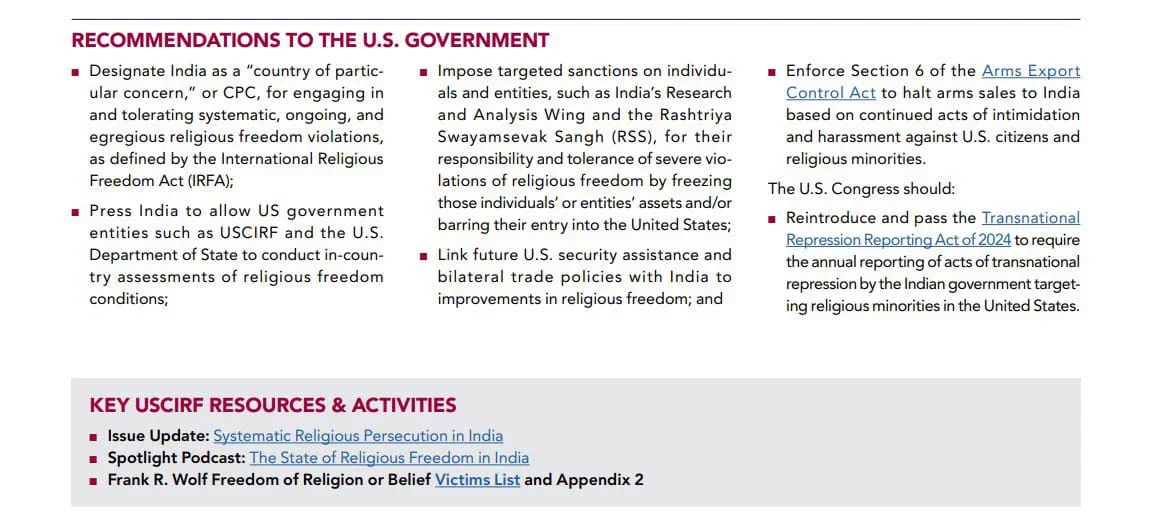
The 2026 report recommended that India be designated as a Country of Particular Concern. The recommendation was based on the commission's assessment of religious freedom conditions during 2025.
The India chapter referred to anti-conversion laws, restrictions affecting religious institutions, alleged discrimination against minority communities and incidents of vigilante violence. It also raised concerns about the treatment of religious minorities, including Muslims and Christians.
The commission argued that certain state-level legislative measures and incidents of violence had contributed to a deterioration in religious freedom conditions. These findings were presented as part of its case for a CPC designation.
Among its most consequential recommendations was the proposal for targeted sanctions against individuals and entities, including the RSS and R&AW. Possible measures included freezing assets and restricting entry into the United States.
The report also recommended linking future US security assistance and bilateral trade policies with improvements in religious freedom. In addition, it called for the enforcement of Section 6 of the Arms Export Control Act to halt arms sales to India, citing alleged intimidation and harassment involving US citizens and religious minorities.
These were recommendations addressed to the US government, not sanctions that had already been imposed. Their significance lies in the potential policy consequences if the relevant American authorities were to adopt them.
The inclusion of R&AW, India's external intelligence agency, alongside the RSS also widened the diplomatic implications of the report. The proposed measures were no longer limited to criticism of domestic laws or public incidents; they extended to an Indian intelligence institution and a major socio-cultural organisation.
275 Former Judges and Officials Question the Report
The controversy gained another dimension when 275 former judges, civil servants and armed forces veterans criticised the USCIRF report in a joint statement issued in March 2026.
The group described the report as disturbing and “completely off-the-mark”, questioning its analytical balance and the way Indian institutions and organisations had been portrayed. The statement also objected to the recommendation for targeted sanctions against the RSS and R&AW.
According to reports, the signatories included 25 retired judges, 119 former bureaucrats, including 10 former ambassadors, and 131 retired armed forces officers. Among those named were former Supreme Court judges Justice Adarsh Kumar Goel and Justice Hemant Gupta, former Chief Election Commissioners O.P. Rawat and Sunil Arora, and former Foreign Secretary Kanwal Sibal.
The statement argued that assessments of religious freedom should be based on verifiable evidence, broader social context and an understanding of India's constitutional institutions. It also referred to India's democratic processes, judicial oversight and parliamentary system as important safeguards.
The intervention gave the government's objections wider public visibility. However, the professional backgrounds of the signatories do not, by themselves, settle the factual questions raised by the USCIRF report. Equally, the commission's recommendations cannot be treated as conclusive merely because they appear in an official annual assessment.
Both positions require examination against evidence, legal standards and the specific incidents being discussed.
Religious Freedom Under India's Constitutional Framework
India's constitutional framework provides several safeguards for freedom of religion and the rights of religious minorities. Article 25 guarantees freedom of conscience and the right to freely profess, practise and propagate religion, subject to public order, morality, health and other provisions of Part III.
Article 26 protects the rights of religious denominations to manage their religious affairs, while Articles 27 and 28 deal with freedom from certain forms of taxation for religious promotion and religious instruction in educational institutions. Articles 29 and 30 provide protections for cultural and educational rights, including the right of minorities to establish and administer educational institutions.
These provisions form an important part of India's constitutional commitment to religious freedom and pluralism. Their implementation, however, is assessed through legislation, administrative action, judicial interpretation and the protection of individual rights.
Several state-level anti-conversion laws, for instance, have been challenged on constitutional grounds. Questions surrounding their scope, enforcement and impact on religious freedom have been examined through public debate and litigation. Such disputes demonstrate why the relationship between state regulation and individual religious liberty remains a significant constitutional issue.
The existence of constitutional guarantees is an important starting point, but it does not automatically resolve every allegation of discrimination or violence. Similarly, the presence of complaints or reported incidents does not, on its own, establish that the government has systematically violated religious freedom. Each claim requires evidence, context and an assessment of the response by the relevant authorities.
A credible assessment must therefore consider both the constitutional protections available and the manner in which they are implemented.
The Wider Implications for India–US Relations
The USCIRF recommendations have emerged at a time when India and the United States maintain a broad strategic partnership. Cooperation extends across defence, trade, technology, critical minerals, education, space and the Indo-Pacific region.
The two countries also work together through platforms such as the Quad, alongside bilateral initiatives aimed at strengthening economic and security cooperation. Differences over human rights and religious freedom can therefore carry implications beyond the immediate subject of the report.
If recommendations involving sanctions, arms sales or trade policy were adopted by the US government, they could introduce additional pressure into an already complex relationship. Even without implementation, such proposals can influence public debate, political perceptions and diplomatic engagement.
For India, the issue is linked to the principle that domestic institutions and constitutional processes should not be judged through selective or politically influenced assessments. For the United States, religious freedom remains an established element of its foreign policy framework and statutory responsibilities.
The challenge lies in preventing disagreement over human rights assessments from overshadowing areas of mutual interest. A mature partnership requires space for differences, but it also requires that criticism be supported by credible evidence and communicated through diplomatic channels.
Beyond Political Positions: The Need for Credible Assessment
The disagreement over the USCIRF report highlights a larger challenge in international human rights monitoring: the need to balance independent scrutiny with methodological fairness.
International commissions have an important role in documenting violations and drawing attention to concerns that may otherwise receive limited public attention. Their work, however, depends on the credibility of their sources, the transparency of their methodology and the consistency with which standards are applied.
For India, rejecting the report does not remove the need to address genuine concerns about religious freedom, discrimination or violence wherever they arise. Constitutional guarantees must be reflected in the everyday protection of citizens, and allegations of wrongdoing should be investigated through established legal processes.
Similarly, international assessments should distinguish between verified incidents, allegations, government policies and judicial findings. Recommendations involving sanctions or restrictions require an especially clear evidentiary basis because of their potential diplomatic and economic consequences.
The debate should not become a contest in which one side's criticism is automatically accepted and the other side's response is automatically dismissed. The credibility of any assessment depends on whether its conclusions can withstand examination.
A Disagreement That Goes Beyond One Report
India's rejection of the USCIRF 2026 report has brought the relationship between religious freedom, national sovereignty and international accountability back into focus. The recommendations for a CPC designation and targeted sanctions have made the disagreement more consequential than a routine exchange of diplomatic statements.
The criticism from former judges, officials and armed forces veterans has added another layer to the debate, while the commission's findings have kept questions about minority rights and the implementation of constitutional protections in the public domain.
Ultimately, the credibility of international monitoring depends on consistency, evidence and institutional independence. Equally, the strength of India's response will be judged not only by its diplomatic objections but also by the effectiveness with which constitutional protections are upheld.
The larger question is not whether a country can be scrutinised, but whether that scrutiny is fair, evidence-based and applied without selectivity. That is the standard by which both international assessments and national responses must be judged.
Share this Perspective
Spread rigorous policy evaluation across your professional networks.