
India’s expanding used-vehicle market is being constrained by fragmented state procedures, unpredictable transfer costs and delays in completing legal ownership formalities.
Key Highlights
- Andhra Pradesh tops the EVOI 2026 with 5.91 out of 10, followed by Kerala at 5.74. Uttar Pradesh ranks last with 2.47.
- 15 states were assessed, representing more than 85% of India's organised used-vehicle market, across six pillars covering regulation, digital infrastructure, efficiency, transparency, institutional support and affordability.
- Hidden costs remain a major concern: the report says actual ownership-transfer expenses can approach 10 times the prescribed statutory fees in some cases.
- Consumer difficulties persist: 39% of surveyed citizens reported pending Registration Certificate (RC) transfers, 63% could not estimate the total transfer cost, and all respondents reported relying on intermediaries.
Buying a second-hand car is often considered a practical way to own a vehicle without bearing the high upfront cost of a new one. Yet, completing the purchase does not always mean that the vehicle has legally been transferred to the buyer. Registration records may remain unchanged, physical visits to Regional Transport Offices (RTOs) may still be required, and additional expenses can emerge during the process.
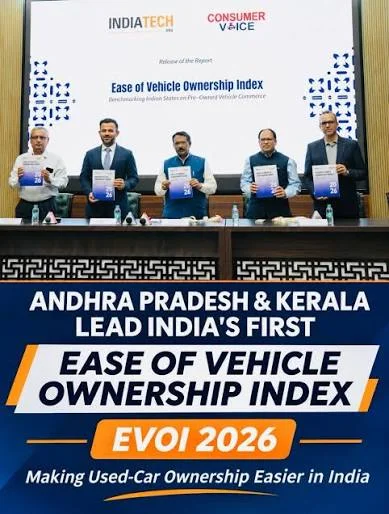
These difficulties have been highlighted by India's first Ease of Vehicle Ownership Index (EVOI) 2026, which has assessed how easily buyers and sellers can complete ownership transfers of pre-owned vehicles across different states.
Released on November 4, 2026, the index was prepared by IndiaTech.org in partnership with consumer organisation Consumer VOICE. Andhra Pradesh has secured the highest score, while Uttar Pradesh has been placed at the bottom. However, the broader finding is that no state has yet established a consistently smooth and affordable ownership-transfer system.
For millions of consumers entering the used-vehicle market, the findings raise a practical question: why does transferring ownership continue to be difficult when much of the vehicle transaction process has already moved online?
Andhra Pradesh leads, but no state crosses six
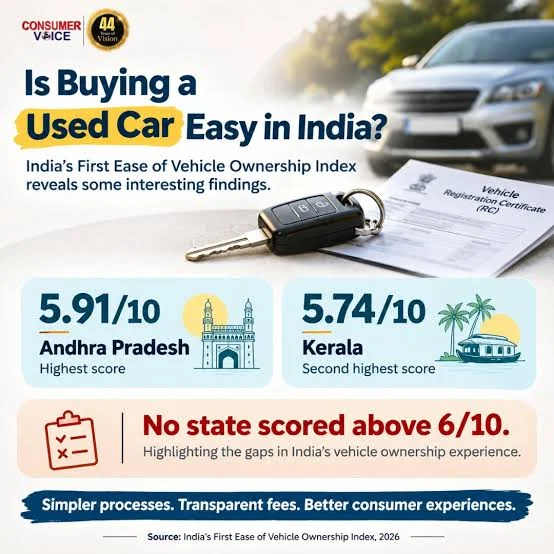
Andhra Pradesh has topped the first edition of the Ease of Vehicle Ownership Index with a score of 5.91 out of 10. Kerala has secured second place with 5.74, while Tamil Nadu and Delhi have jointly occupied the third position with 4.58 each.
Karnataka has been placed fifth with 4.30, followed by Gujarat at 4.16, Madhya Pradesh at 4.10, Maharashtra and Telangana at 4.09 each, and Punjab at 4.03. Rajasthan and Haryana have recorded scores of 3.97 and 3.86, respectively.
At the lower end, West Bengal has scored 2.56, Bihar 2.51 and Uttar Pradesh 2.47.
Rank | State | Score out of 10 |
1 | Andhra Pradesh | 5.91 |
2 | Kerala | 5.74 |
3 | Tamil Nadu | 4.58 |
4 | Delhi | 4.58 |
5 | Karnataka | 4.30 |
6 | Gujarat | 4.16 |
7 | Madhya Pradesh | 4.10 |
8 | Maharashtra | 4.09 |
9 | Telangana | 4.09 |
10 | Punjab | 4.03 |
11 | Rajasthan | 3.97 |
12 | Haryana | 3.86 |
13 | West Bengal | 2.56 |
14 | Bihar | 2.51 |
15 | Uttar Pradesh | 2.47 |
The rankings reveal considerable differences in how ownership transfers are administered. However, the limited distance between several states also suggests that the problem is not confined to a few poorly performing jurisdictions.
Importantly, Andhra Pradesh's leading position should not be mistaken for a fully seamless system. Its score remains below six, indicating that considerable scope for improvement exists even in the highest-ranked state.
What does the index actually measure?
The EVOI has been designed to assess the experience of transferring ownership of pre-owned vehicles, rather than the overall performance of a state's transport department or its automobile industry.
Six pillars have been used to calculate the scores:
- Policy and Regulatory Framework – 20%: Clarity and consistency of ownership-transfer rules.
- Digital Infrastructure and Services – 20%: Availability and reliability of online systems.
- Process Efficiency and Timeliness – 20%: Speed of processing, predictability and procedural burden.
- Transparency and Accountability – 10%: Fee clarity, application tracking and grievance redressal.
- Institutional Ecosystem – 15%: Consumer protection, dealer support and trade infrastructure.
- Cost and Affordability – 15%: Difference between official fees and the actual cost incurred during transfers.
The assessment covers 15 states, representing more than 85% of India's organised used-car market. It combines an examination of regulatory procedures with consumer experiences, stakeholder consultations and an assessment of administrative practices.
The methodology is important because a digital application alone cannot establish whether a service is genuinely convenient. If an applicant is required to submit documents physically after completing an online application, or must depend on an intermediary to understand the process, digitisation has not fully translated into ease of ownership.
The hidden cost of transferring a vehicle
One of the most significant findings concerns the difference between prescribed government charges and the amount consumers may actually spend.
According to the report, cost and affordability have emerged as the weakest areas of the ownership-transfer ecosystem. Twelve of the 15 states assessed scored below 3.5 on this pillar.
Manual verification, repeated documentation, physical appearances, notary-related requirements and multiple administrative stages have been identified as factors contributing to additional expenses.
The Indian Express reported that Consumer VOICE cited cases in which the actual cost of transferring ownership could approach 10 times the prescribed statutory fee.
In Bihar, a single transfer was reported to cost approximately ₹13,000–₹14,000 over and above the fee prescribed on the VAHAN portal. At border RTOs in Tamil Nadu, including Hosur and Krishnagiri, an official charge of around ₹800 was reported to increase to ₹7,000–₹8,000.
These figures illustrate the potential financial burden, although they should not be treated as fixed charges applicable to every transaction in those states.
The problem becomes particularly relevant for consumers purchasing vehicles at relatively low prices. When additional administrative expenses are difficult to anticipate, the affordability advantage of buying a pre-owned vehicle can be reduced.
For organised dealers, unpredictable transfer expenses can also affect inventory movement, transaction planning and customer confidence.
Online applications have not eliminated physical visits
The continued dependence on physical procedures has exposed another weakness in the system.
The report found that applicants in 13 of the 15 assessed states were required to submit physical documents to RTOs even after filing applications online. This creates a dual process in which digital services are used for initial submission, but final processing continues to depend on physical verification or documentation.
Registration Certificate transfer delays have also been reported. According to the study, transfer timelines range from approximately seven to 10 days in Andhra Pradesh, where biometric authentication of the buyer, seller and lender is used, to more than 30 days in Uttar Pradesh.
A delayed RC transfer can create uncertainty for both parties. Although the vehicle may have been handed over and payment completed, the official registration record may continue to reflect the previous owner's details.
This can complicate subsequent transactions and create difficulties in resolving issues involving insurance, traffic penalties or other vehicle-related liabilities.
The report also found that 39% of surveyed citizens were still waiting for their RC transfers after completing their vehicle transactions. The figure points towards a gap between the completion of a commercial transaction and the completion of the corresponding government process.
Why do buyers and sellers depend on intermediaries?
The findings on consumer experience offer another indication of the administrative difficulties involved.
The report found that 63% of surveyed citizens could not accurately estimate the total cost of transferring vehicle ownership. Further, 61.5% were unaware of Party Peshi requirements until they reached the RTO.
Party Peshi refers to the requirement for the concerned parties to appear before the relevant authority for verification or completion of formalities in certain circumstances.
Most strikingly, all respondents in the survey reported relying on intermediaries or agents to complete ownership-transfer procedures.
This dependence reflects more than a preference for convenience. When requirements are unclear, online systems are incomplete and processing timelines are uncertain, consumers may find it difficult to navigate the process independently.
Intermediaries can help with documentation, application submission and follow-up. However, when their involvement becomes necessary for routine government services, the additional expense is effectively transferred to the consumer.
The report's survey findings should be understood within the scope of its respondent sample, rather than as a claim that every used-vehicle transaction across India requires an agent.
Interstate transfers and road tax create another layer of difficulty
The transfer of a vehicle from one state to another can involve additional documentation, tax calculations and refund procedures.
Although the Motor Vehicles Act and Central Motor Vehicles Rules provide the national legal framework, implementation is largely handled by state transport departments. As a result, procedures, documentation requirements and administrative practices can differ across jurisdictions.
Road tax is one of the most visible examples of this variation.
The Indian Express reported that the road tax on a petrol car valued at ₹6 lakh can range from 3% in Uttar Pradesh to 14% in Karnataka. The difference can translate into an additional burden of more than ₹66,000 on the same vehicle, depending on the applicable tax rules and transaction circumstances.
Refunds of road tax paid in the original state can also become difficult to obtain. According to the index, Andhra Pradesh and Telangana are the only two assessed states with functioning road tax refund mechanisms.
This becomes particularly relevant for consumers relocating between states, dealers moving inventory across borders and businesses operating through multiple regional markets.
A vehicle purchased in one state should not become unnecessarily difficult or expensive to register in another simply because administrative procedures are not adequately coordinated.
What can other states learn from Andhra Pradesh and Kerala?
The leading states have demonstrated certain practices that could inform wider administrative reforms.
Andhra Pradesh's performance has been supported by biometric pre-authentication of parties involved in ownership transfers at available centres. This can reduce the need for repeated physical appearances and help establish the identity of the buyer and seller.
Kerala has recorded the second-highest overall score and performed comparatively well in digital infrastructure. However, the report also identifies continuing gaps in transparency, showing that stronger online systems do not automatically eliminate every procedural difficulty.
Other examples have also been identified. West Bengal permits video-call-based seller verification at select RTOs, reducing the need for physical appearances in those cases. Telangana and Andhra Pradesh have been recognised for their functioning road tax refund mechanisms.
The report also identifies Kerala, Rajasthan and West Bengal as states where the deemed ownership framework has been operationalised by dealers and agents.
These practices demonstrate that improvements can be achieved through administrative changes and better implementation of existing provisions, rather than relying entirely on new legislation.
Deemed ownership: An important but underused provision
A significant issue identified by the report concerns the implementation of the deemed ownership framework under the Motor Vehicles Act.
The framework is intended to provide greater clarity about ownership and responsibility when vehicles are held or transferred through authorised dealers. It is particularly relevant to organised pre-owned vehicle businesses that acquire vehicles from sellers and subsequently transfer them to new buyers.
The report notes that 22 states have formally incorporated deemed ownership into their regulatory frameworks, but its actual use remains limited.
In some jurisdictions, dealer registrations under the framework remain extremely low. Delhi, Karnataka and Telangana, for example, were identified as having no registered dealers under the mechanism at the time of the assessment.
The gap between formal adoption and practical implementation creates uncertainty for dealers and consumers. When responsibilities during the holding and transfer period are not clearly operationalised, additional documentation and liability concerns can arise.
Wider implementation of the framework, supported by clear procedures and dealer registration, could help improve accountability and reduce unnecessary complications in organised vehicle transactions.
The used-vehicle market is growing faster than its administrative system
The importance of these findings becomes clearer when viewed against the size and expected growth of India's pre-owned vehicle market.
According to the report, the market was valued at approximately $36.4 billion in 2024–25 and is projected to reach $73.5 billion by 2030. The ratio of used-vehicle sales to new-vehicle sales is also expected to rise from 1.3:1 to 1.7:1 over the same period.
This expansion is being supported by affordability and changing consumer preferences. The report estimates that 60–65% of buyers in the organised pre-owned vehicle market are first-time car owners.
The average selling price of a used car increased from ₹4.49 lakh in 2021 to ₹5.47 lakh in 2025. By comparison, the average price of a new passenger vehicle was approximately ₹11.5 lakh in 2024.
For many households, a pre-owned vehicle therefore represents a more accessible route to personal mobility.
The market also supports employment across dealerships, vehicle inspection services, financing, insurance, logistics, repairs and digital platforms. A more formal and transparent transaction system could strengthen these activities while improving consumer protection.
The environmental dimension is also relevant. When a pre-owned vehicle purchase replaces the purchase of a new vehicle, the lifecycle of an existing asset is extended. The report cites an estimated saving of 5–8 tonnes of carbon emissions associated with manufacturing and supply-chain activities in such a substitution.
However, these potential economic and environmental benefits can be constrained if ownership transfers remain expensive and unpredictable.
Eight reforms proposed to simplify vehicle transfers
The EVOI 2026 report has outlined eight priorities to improve the ownership-transfer process. These recommendations focus on making procedures more consistent, reducing manual intervention and improving coordination between government departments and financial institutions.
1. A unified digital vehicle-record system
A cloud-based system integrating vehicle ownership records, digital identity verification and relevant documents has been proposed. Wider acceptance of DigiLocker and mParivahan documents has also been recommended to reduce repeated physical submissions.
2. Fixed timelines for service delivery
Transparent and enforceable Service Level Agreements have been recommended across the RTO system. The report proposes service completion timelines of less than 24 hours for relevant processes, supported by application tracking and accountability.
3. Uniform NOC procedures
A standardised national framework for No Objection Certificates could reduce differences in documentation, validity periods and approval requirements across states. This would be particularly useful for interstate transfers.
4. Effective implementation of deemed ownership
The existing framework should be operationalised across jurisdictions so that authorised dealers can complete transactions with greater clarity about ownership and liability.
5. Automatic removal of hypothecation
When a vehicle loan is repaid, the hypothecation recorded against it should be removed without repeated manual coordination. Real-time integration between banks and the VAHAN or Parivahan system has been proposed to simplify this process.
6. Transparent and consolidated payments
A unified digital payment gateway could bring statutory fees and authorised service charges together. This would help consumers understand the actual cost before completing a transaction.
7. A more consistent road tax framework
The report recommends a more harmonised national approach to road taxation, along with a workable refund mechanism, to reduce double taxation and complications during interstate transfers.
8. Simplified challan clearance
Pending traffic penalties can prevent ownership transfers from being completed. The report proposes that authorised stakeholders should be permitted to clear outstanding challans through a streamlined process.
These are recommendations made by the index's authors, not a statement that the proposed reforms have already been adopted by the government.
Government response and the road ahead
The findings have also brought attention to the role of the Union government in coordinating reforms across state transport systems.
At the launch of the index on November 4, Minister of State for Road Transport and Highways Harsh Malhotra acknowledged the difficulties faced by consumers during used-vehicle ownership transfers. He said that the government was working on policies to simplify the process and stressed the importance of coordination between central policies and state-level implementation.
The challenge is partly institutional. While the national legal framework is provided centrally, much of the day-to-day ownership-transfer process is administered by state transport departments and local RTOs. Improvements therefore require coordination across multiple authorities rather than the introduction of a single online portal.
The proposed reforms would need to be accompanied by clear service standards, reliable digital infrastructure, transparent charges and effective grievance redressal. A digital application that cannot resolve a stalled transaction or provide a clear explanation of additional fees will offer limited relief to consumers.
The performance of states should also be assessed through measurable outcomes: how quickly RC transfers are completed, how many applications require physical visits, whether official fees match the final amount paid, and whether consumers can complete transactions without unnecessary assistance.
The Ease of Vehicle Ownership Index 2026 has provided a first comparative assessment of these challenges. Its larger contribution will depend on whether the findings are translated into administrative improvements.
India's used-vehicle market is expected to become an increasingly important part of the country's mobility economy. But its growth cannot be measured only through sales volumes and market valuations. The ease with which a buyer can legally become the owner of a vehicle is equally important.
A used car may be purchased in a day, but its ownership should not take weeks to establish.
Share this Perspective
Spread rigorous policy evaluation across your professional networks.